
June 4, 2026
Buying in Key Largo is not just about finding a home you love. It is about understanding flood risk, boating access, insurance, permitting, and how you plan to use the property year-round or seasonally. If you are coming from Miami, another part of Florida, or out of state, a little upfront planning can save you time, money, and stress later. Let’s dive in.
In Key Largo, coastal risk is not a side note. Monroe County says all of the county is identified as a coastal floodplain, which means flood review should be part of your standard buying process.
That matters because homeowners insurance does not cover flood damage. Before you move forward on a property, you will want to review flood zone information, ask for elevation details, think through storm planning, and get insurance quotes early.
Monroe County also advises buyers to check permitting history before closing. If work was done without permits, the new owner may have to correct those issues at their own expense.
In Key Largo, many buying decisions come down to one simple question: How do you want to use the water? That answer often shapes both your budget and your day-to-day ownership experience.
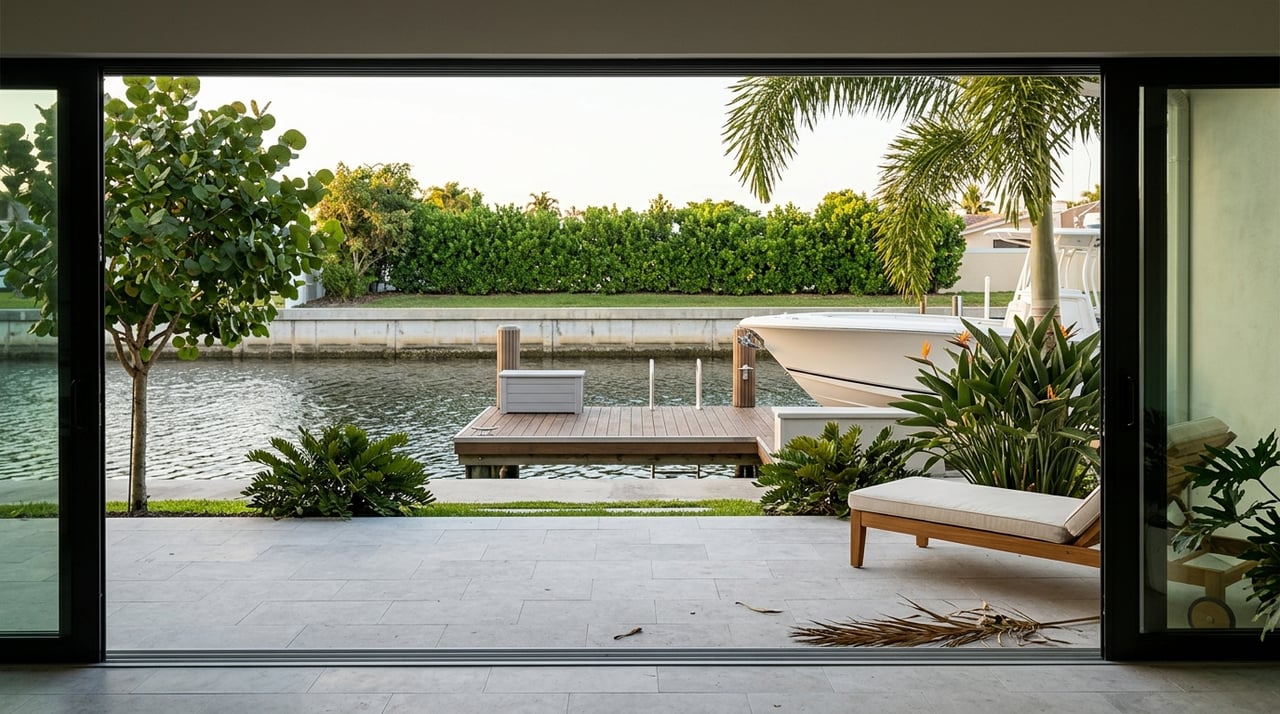
Some buyers prefer a non-waterfront home with less maintenance. Others want canal-front access with room for a dock or boat lift, while some lean toward a condo or HOA-managed property for lower hands-on upkeep.
There are also buyers who prioritize boating convenience over direct waterfront ownership. Monroe County maintains marine resources and waterfront infrastructure throughout the Keys, which makes public access part of the conversation.
A waterfront premium may make sense for you, but it is smart to compare that cost against nearby public launch options. In Key Largo, Monroe County has a public boat ramp at Mike Forster Memorial Park.
Rowell’s Waterfront Park also offers a kayak and paddleboard launch, though boats and personal watercraft are not allowed there. If you only boat occasionally, nearby public access may change how much value you place on private dockage.
If you use the water often, direct access may still be worth the extra cost. The key is to match the property to your lifestyle, not just the listing photos.
Waterfront ownership in Key Largo often includes navigation and compliance considerations that buyers from inland markets may not expect. Monroe County Marine Resources manages boating and waterway infrastructure, and the county maintains more than 300 channel markers and 251 regulatory markers across the Keys.
That means channel depth, shallow-water navigation, and boating restrictions can affect how easily you use your boat. A home that looks ideal on paper may feel very different once you factor in route access and daily convenience.
If you plan to keep a boat, you should also understand the Florida Keys No Discharge Zone and Monroe County pump-out rules. Monroe County says vessels anchored or moored for more than ten consecutive days must provide proof of pump-out.
The county notes there are more than 30 shoreside pump-out facilities and a Keys-wide mobile pump-out service. For buyers considering a property with marina features or liveaboard use, this becomes an important operating and compliance detail.
If you are evaluating a marina-related asset or a property with liveaboard potential, be especially careful. Monroe County requires fixed pump-out systems for unincorporated-area marinas with 10 or more slips or at least one liveaboard slip.
That requirement can affect both your ownership costs and your long-term plans for the property. It is one of several reasons why waterfront due diligence in Key Largo should go beyond a basic residential review.
A standard home inspection is only the beginning in the Florida Keys. For many homes older than 20 years, Citizens says a four-point inspection is commonly required for underwriting.
That inspection focuses on the roof, electrical, plumbing, and HVAC systems. You may also want a wind-mitigation inspection, since qualifying wind-resistance features can support insurance credits or discounts.
In Key Largo, waterfront and elevated homes often need even closer review. Monroe County’s building inspection list includes items such as seawalls, boat lifts or davits, floodproofing, FEMA compliance, and preliminary and final elevation certificates.
If the home is waterfront or elevated, verify the property’s vertical elevation and any shoreline improvements before closing. That includes confirming whether seawalls, docks, lifts, or similar structures were properly permitted and inspected.
Monroe County code says permits are required before erecting, altering, constructing, or installing buildings, structures, or service systems. For work over water, such as docks, seawalls, and boat lifts, the county also requires a signed work-over-water notice at permit issuance.
This is where local review matters. A missing permit or unresolved issue can become your responsibility after closing.
Many buyers are drawn to elevated homes in the Keys, but the space below those homes needs careful attention. Monroe County says enclosed space below elevated homes may be used only for limited storage, parking, or access.
It cannot be converted to habitable living space under federal floodplain rules. If a lower-level enclosure looks improved or furnished like living space, that is a sign to investigate permits, code compliance, and legal use very closely.
This is also why seller disclosures alone are not enough. Monroe County encourages buyers to review FEMA flood zones, county flood maps, elevation certificates, and permitting history as part of floodplain due diligence.
Key Largo is not a market where future changes are always quick or simple. The Florida Keys are managed under Monroe County’s ROGO and NROGO system, which is tied to a 24-hour hurricane evacuation model and used to allocate residential and nonresidential building permits.
For buyers, that can mean new construction, major rebuilds, and some additions may be more constrained and slower to permit than in inland areas. If your plan is to renovate heavily or expand soon after purchase, you should factor that into your timeline before making an offer.
If this will be your second home or vacation property, taxes may work differently than you expect. Monroe County’s Property Appraiser says the homestead exemption applies to property used as the owner’s primary residence, and rental property does not qualify.
The homestead benefit can reduce assessed value by up to $50,000 and activates the Save Our Homes assessment cap. Those benefits are generally not available for a vacation home unless it becomes your primary residence.
That difference can have a real impact on your carrying costs. It is especially important for buyers comparing Key Largo against a full-time move versus a part-time lifestyle purchase.
If you are hoping to offset costs with short-term rental income, do not assume every property will fit that plan. Monroe County defines a special vacation rental as a dwelling unit rented, leased, or assigned for tenancies of less than 28 days.
Because rental strategy affects underwriting, ownership goals, and compliance, it should be verified early in the search process. This is one area where local guidance can protect you from making assumptions based on another market.
If you will not live in the home full time, management matters almost as much as the purchase itself. In Key Largo, practical ownership often includes hurricane-season readiness, regular exterior checks, corrosion and moisture maintenance, and quick access to contractors or caretakers.
That is why out-of-area buyers usually benefit from a local support team. The most practical purchase process often includes a buyer’s agent familiar with Monroe County rules, an insurance agent who can quote flood and wind coverage early, an inspector who knows Florida Keys construction, and a closing team comfortable with coastal transactions.
For many second-home owners, a property manager or caretaker also becomes part of the long-term plan. It is not just about buying the right home. It is about making sure the home is protected and workable when you are away.
Key Largo purchases often involve more moving parts than a typical mainland transaction. Insurance, flood review, elevation verification, permit history, and dock or seawall questions can all affect whether a property truly fits your goals.
That does not mean buying here has to feel overwhelming. It means your process should be organized, proactive, and local from day one.
If you are considering a home in Key Largo, working with a team that understands South Florida coastal buying can help you move with more clarity and confidence. To discuss your goals and the next steps, connect with Khosh Bosh Real Estate.
Stay up to date on the latest real estate trends.

We are full service Brokerage located in the AKA Hotel Brickell and yet connected Globally. Let us guide you through your home buying and selling journey, contact us today!

KHOSH BOSH REAL ESTATE
OFFICE DIRECT LINE
(305) 967-6342
MOBILE DIRECT MOBILE
(786) 346-8282
EMAIL
[email protected]
OPEN HOURS
8am-8pm Mon-FrI
OFFICE ADDRESS
1395 BRICKELL AVE., SUITE #800
MIAMI, FL 33131